
UNIMONTES 2018
The age you feel means more than your actual birthdate
Most people feel younger or older than they really are – and this ‘subjective age’ has a big effect on their physical and mental health.
Imagine, for a moment, that you had no birth certificate and your age was simply based on the way you feel
inside. How old would you say you are?
Like your height or shoe size, the number of years that have passed since you first entered the world is an
unchangeable fact. But everyday experience suggests that we often don’t experience ageing the same way,
[5] with many people feeling older or younger than they really are.
Scientists are increasingly interested in this quality. They are finding that your ‘subjective age’ may be
essential for understanding the reasons that some people appear to flourish as they age – while others fade.
“The extent to which older adults feel much younger than they are may determine important daily or life
decisions for what they will do next,” says Brian Nosek at the University of Virginia.
[10] Its importance doesn’t end there. Various studies have even shown that your subjective age also can predict
various important health outcomes, including your risk of death. In some very real ways, you really are
‘only as old as you feel’.
Given these enticing results, many researchers are now trying to unpick the many biological, psychological,
and social factors that shape the individual experience of ageing – and how this knowledge might help us
[15] live longer, healthier lives.
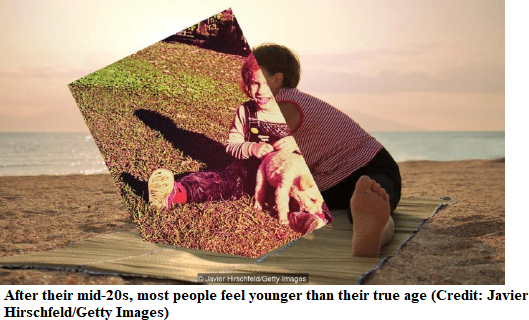 This new understanding of the ageing process has been decades in the making. Some of the earliest studies
charting the gap between felt and chronological age appeared in the 1970s and 1980s. That trickle of initial
interest has now turned into a flood. A torrent of new studies during the last 10 years have explored the
potential psychological and physiological consequences of this discrepancy.
One of the most intriguing strands of this research has explored the way subjective age interacts with our
[20] personality. It is now well accepted that people tend to mellow as they get older, becoming less extroverted
and less open to new experiences – personality changes which are less pronounced in people who are
younger at heart and accentuated in people with older subjective ages.
Interestingly, however, the people with younger subjective ages also became more conscientious and less
neurotic – positive changes that come with normal ageing. So they still seem to gain the wisdom that comes
[25] with greater life experience. But it doesn’t come at the cost of the energy and exuberance of youth. It’s not
as if having a lower subjective age leaves us frozen in a state of permanent immaturity.
Feeling younger than your years also seems to come with a lower risk of depression and greater mental
wellbeing as we age. It also means better physical health, including your risk of dementia, and less of a
chance that you will be hospitalised for illness.
[30] Yannick Stephan at the University of Montpellier examined the data from three longitudinal studies which
together tracked more than 17,000 middle-aged and elderly participants. […]
Fonte: ROBSON, David. The age you feel means more than your actual birthdate. Disponível em: http://www.bbc.com/future/story/20180712-the-age-you-feel-means-more-than-your-actual-birthdate. Publicado em: 19 jul. 2018. Acesso em: 21 jul. 2018.
According to the text, it is INCORRECT to state that:
The number of years that you have lived since you were born is something unchangeable.
Most people feel older than they really are but it does not affect their physical health, only their mental health.
Studies show that your subjective age can also predict various important health outcomes, including your risk of death.
After you turn about 24 to 26, you tend to feel younger than your true age.
Insights de Estudo
Taxa de Acerto
Material de Estudo
Conteúdo Exclusivo
Cadastre-se para ver dicas, estratégias e análise completa desta questão
Criar conta grátis →🎓 AIO + UNIMONTES: Preparação Baseada em Dados
Fizemos o trabalho difícil para você não ter que fazer
Transforme seus estudos com a AIO!
Estudantes como você estão acelerando suas aprovações usando nossa plataforma de AI + aprendizado ativo