
UFVJM 2011/2
Read the text below and answer question.
Stay away from energy drinks, doctors say
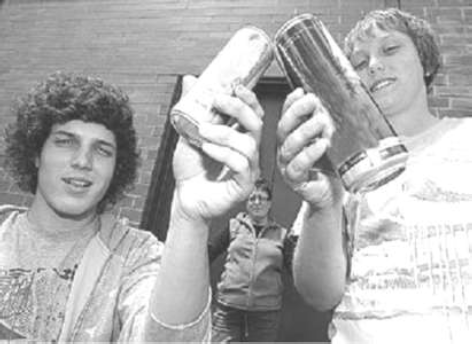
[1] (Reuters Health) - In a new report, a large group of American doctors urge kids and
teens to avoid energy drinks and only consume sports drinks in limited amount. The
recommendations come in the wake of a national debate over energy drinks, which experts
fear may have side effects."Children never need energy drinks," said Dr. Holly Benjamin, of
[5] the American Academy of Pediatrics, who worked on the new report. "They contain caffeine
and other stimulant substances that aren't nutritional, so you don't need them."And kids
might be more vulnerable to the contents of energy drinks than grownups."If you drink them
on a regular basis, it stresses the body," Benjamin told Reuters Health. "You don't really want
to stress the body of a person that's growing."
[10] For the new recommendations, published in the journal Pediatrics, researchers went
through earlier studies and reports on both energy drinks and sports drinks, which don't
contain any stimulants. They note that energy drinks contain a jumble of ingredients --
including vitamins and herbal extracts -- with possible side effects that aren't always well
understood. While there aren't many documented cases of harm directly linked to the
[15] beverages, stimulants can disturb the heart's rhythm and may lead to seizures in very rare
cases, Benjamin said. Recently, she saw a 15-year-old boy with attention deficit hyperactivity
disorder who came into the hospital with a seizure after having drunk two 24-ounce bottles of
Mountain Dew, a soft drink that contains caffeine. The boy was already taking stimulant
ADHD medication, and the extra caffeine in principle might have pushed him over the edge,
[20] according to Benjamin. "You just never know," she said. "It's definitely a concern."
Earlier this year, Pediatrics published another review of the literature on energy
drinks. In it, Florida pediatricians described cases of seizures, delusions, heart problems and
kidney or liver damage in people who had drunk one or more non-alcoholic energy drinks --
including brands like Red Bull, Spike Shooter and Redline. While they acknowledged that
[25] such cases are very rare, and can't be conclusively linked to the drinks, they urged caution,
especially in kids with medical conditions. U.S. sales of non-alcoholic energy drinks are
expected to hit $9 billion this year, with children and young adults accounting for half the
market. Manufacturers claim their products will enhance both mental and physical
performance, and were quick to downplay the February report."The effects of caffeine are
[30] well-known and as an 8.4 oz can of Red Bull contains about the same amount of caffeine as
a cup of coffee (80 mg), it should be treated accordingly," Red Bull said in an emailed
statement to Reuters Health.
Benjamin said that for most kids, water is the best thing to quench their thirst. If they
happen to be young athletes training hard, a sports drink might be helpful, too, because it
[35] contains sugar. But for kids who lead less-active lives, sports and energy drinks might just
serve to pile on extra pounds, fueling the national obesity epidemic. While she acknowledged
that more research is needed, Benjamin said the safest thing to drink is water.
Source / text : bit.ly/cxXOG Pediatrics, online May 30, 2011. http://www.reuters.com/article/2011/05/30/us-energy-drinks-idUSTRE74T11O20110530 (adapted)
Source / picture: http://www.impactlab.net/2011/02/14/doctors-warn-energy-drinks-putting consumers-at-risk-as-sales-soar/ NEW YORK | Mon May 30, 2011 4:12am EDT By Frederik Joelving
Glossary:
Acknowledged: reconhecer
Avoid: evitar
Beverages: bebidas
Caution: precaução
Concern: preocupação
Delusions: alucinações
Downplay: minimizar a importância
Enhance: aumentar, intensificar
Fear: temer
Fueling: contribuindo
Harm: dano
Kidney: rim
Liver: fígado
Quench: saciar
Sales: vendas
Seizures: ataques, convulsões
Thirst: sede
Two 24-ounce-bottles: duas garrafas de aproximadamente 750 ml
Urge: recomendar
8,4 oz can: lata de aproximadamente 250 ml
According to Florida pediatricians,
the US should prohibit the sales of energy drinks.
energy drinks contain the same amount of caffeine as a cup of coffee.
energy drinks don’t affect both mental and physical performance of children.
children with medical conditions should consume energy drinks with caution.
Insights de Estudo
Taxa de Acerto
Material de Estudo
Conteúdo Exclusivo
Cadastre-se para ver dicas, estratégias e análise completa desta questão
Criar conta grátis →🎓 AIO + UFVJM: Preparação Baseada em Dados
Fizemos o trabalho difícil para você não ter que fazer
Transforme seus estudos com a AIO!
Estudantes como você estão acelerando suas aprovações usando nossa plataforma de AI + aprendizado ativo