
UFSM 2011
Para responder à questão abaixo, leia o texto a seguir.
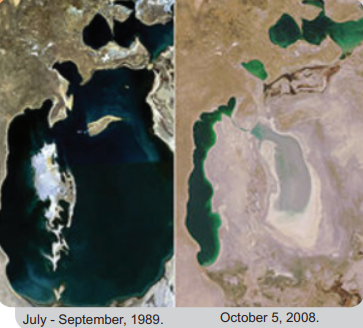
Aral Sea
1 The Aral Sea is a saline endorheic basin in Central Asia; it lies between Kazakhstan (Aktobe and Kyzylorda provinces) in
the north and Karakalpakstan, an autonomous region of Uzbekistan, in the south. The name roughly translates as
"Sea of Islands", referring to more than 1,500 islands that once dotted its waters.
Formerly one of the four largest lakes of the world with an area of 68,000 square kilometres (26,000 sq mi), the Aral Sea
5 has been steadily shrinking since the 1960s after the rivers that fed it were diverted by Soviet Union irrigation projects.
By 2007, it had declined to 10% of its original size, splitting into three lakes – the North Aral Sea and the eastern and
western basins of the once far larger South Aral Sea. By 2009, the south-eastern lake had disappeared and the
south-western lake retreated to a thin strip at the extreme west of the former southern sea.The maximum depth of the
North Aral Sea is 42 metres (138 ft) (as of 2008).
10 The region's once prosperous fishing industry has been virtually destroyed, bringing unemployment and economic
hardship. The Aral Sea region is also heavily polluted, with consequent serious public health problems. The retreat of the
sea has reportedly also caused local climate change, with summers becoming hotter and drier, and winters colder and
longer.
It has been called "one of the planet's worst environmental disasters".
Considere as seguintes afirmações:
I - O mar Aral possuía quase mil ilhas antes de 1960.
II - Em 2007, o mar Aral transformou-se em três lagos.
III - A diminuição de volume do rio aumentou os casos de câncer na população.
Está(ão) correta(s)
apenas II.
apenas I e II.
apenas III.
apenas I e III.
I, II e III.
Insights de Estudo
Taxa de Acerto
🎓 AIO + UFSM: Preparação Baseada em Dados
Fizemos o trabalho difícil para você não ter que fazer
Transforme seus estudos com a AIO!
Estudantes como você estão acelerando suas aprovações usando nossa plataforma de AI + aprendizado ativo